 Add to Chrome
 Add to Firefox
 Add to Edge
Visible Light Positioning With Lamé Curve LEDs: A Generic Approach for Camera Pose Estimation
Feb 02, 2026
Camera-based visible light positioning (VLP) is a promising technique for accurate and low-cost indoor camera pose estimation (CPE). To reduce the number of required light-emitting diodes (LEDs), advanced methods commonly exploit LED shape features for positioning. Although interesting, they are typically restricted to a single LED geometry, leading to failure in heterogeneous LED-shape scenarios. To address this challenge, this paper investigates Lamé curves as a unified representation of common LED shapes and proposes a generic VLP algorithm using Lamé curve-shaped LEDs, termed LC-VLP. In the considered system, multiple ceiling-mounted Lamé curve-shaped LEDs periodically broadcast their curve parameters via visible light communication, which are captured by a camera-equipped receiver. Based on the received LED images and curve parameters, the receiver can estimate the camera pose using LC-VLP. Specifically, an LED database is constructed offline to store the curve parameters, while online positioning is formulated as a nonlinear least-squares problem and solved iteratively. To provide a reliable initialization, a correspondence-free perspective-\textit{n}-points (FreeP\textit{n}P) algorithm is further developed, enabling approximate CPE without any pre-calibrated reference points. The performance of LC-VLP is verified by both simulations and experiments. Simulations show that LC-VLP outperforms state-of-the-art methods in both circular- and rectangular-LED scenarios, achieving reductions of over 40% in position error and 25% in rotation error. Experiments further show that LC-VLP can achieve an average position accuracy of less than 4 cm.

Stacked Intelligent Metasurfaces-Based Electromagnetic Wave Domain Interference-Free Precoding
Jan 27, 2026This paper introduces an interference-free multi-stream transmission architecture leveraging stacked intelligent metasurfaces (SIMs), from a new perspective of interference exploitation. Unlike traditional interference exploitation precoding (IEP) which relies on computational hardware circuitry, we perform the precoding operations within the analog wave domain provided by SIMs. However, the benefits of SIM-enabled IEP are limited by the nonlinear distortion (NLD) caused by power amplifiers. A hardware-efficient interference-free transmitter architecture is developed to exploit SIM's high and flexible degree of freedom (DoF), where the NLD on modulated symbols can be directly compensated in the wave domain. Moreover, we design a frame-level SIM configuration scheme and formulate a maxmin problem on the safety margin function. With respect to the optimization of SIM phase shifts, we propose a recursive oblique manifold (ROM) algorithm to tackle the complex coupling among phase shifts across multiple layers. A flexible DoF-driven antenna selection (AS) scheme is explored in the SIM-enabled IEP system. Using an ROM-based alternating optimization (ROM-AO) framework, our approach jointly optimizes transmit AS, SIM phase shift design, and power allocation (PA), and develops a greedy safety margin-based AS algorithm. Simulations show that the proposed SIM-enabled frame-level IEP scheme significantly outperforms benchmarks. Specifically, the strategy with AS and PA can achieve a 20 dB performance gain compared to the case without any strategy under the 12 dB signal-to-noise ratio, which confirms the superiority of the NLD-aware IEP scheme and the effectiveness of the proposed algorithm.
Achieving Full Multipath Diversity by Random Constellation Rotation: a Theoretical Perspective
Jan 20, 2026Diversity is an essential concept associated with communication reliability in multipath channels since it determines the slope of bit error rate performance in the medium to high signal-to-noise ratio regions. However, most of the existing analytical frameworks were developed for specific modulation schemes while the efficient validation of full multipath diversity for general modulation schemes remains an open problem. To fill this research gap, we propose to utilize random constellation rotation to ease the conditions for full-diversity modulation designs. For linearly precoded cyclic-prefix orthogonal frequency division multiplexing (OFDM) systems, we prove that maximum multipath diversity can be attained as long as the spread matrix does not have zero entries, which is a sufficient but easily satisfied condition. Furthermore, we derive the sufficient and necessary condition for general modulation schemes, whose verification can be divided into validation tasks for each column of the modulation matrix. Based on the proposed conditions, maximum diversity order can be attained with the probability of 1 by enabling a randomly generated rotation pattern for both time and doubly dispersive channels. The theoretical analysis in this paper also demonstrates that the diversity evaluation can be concentrated on the pairwise error probability when the number of error symbols is one, which reduces the complexity of diversity-driven design and performance analysis for novel modulation schemes significantly in both time and doubly dispersive channels. Finally, numerical results for various modulation schemes confirm that the theoretical analysis holds in both time and doubly dispersive channels. Furthermore, when employing practical detectors, the random constellation rotation technique consistently enhance the transmission reliability for both coded and uncoded systems.
Joint Sparsity and Beamforming Design for RDARS-Aided Systems
Jan 05, 2026Reconfigurable distributed antennas and reflecting surface (RDARS) has emerged as a promising architecture for communication and sensing performance enhancement. In particular, the new selection gain can be achieved by leveraging the dynamic working mode selection between connection and reflection modes, whereas low-complexity element configuration remains an open issue. In this paper, we consider a RDARS-assisted communication system, where the connected elements are formed as a uniform sparse array for simplified mode configuration while achieving enlarged physical array aperture. The sum rate maximization problem is then formulated by jointly optimizing the active and passive beamforming matrices and sparsity of connected element array. For the special cases of a single user equipment (UE) and two UEs, the optimal sparsity designs are derived in closed-form. Then, for an arbitrary number of UEs, a weighted minimum mean-square error-based alternating optimization (AO) algorithm is proposed to tackle the non-convex optimization problem. Numerical results demonstrate the importance of optimizing the sparsity and the effectiveness of low-complexity sparsity optimization.
RSMA-Assited and Transceiver-Coordinated ICI Management for MIMO-OFDM System
Dec 19, 2025


High-mobility scenarios are becoming increasingly critical in next-generation communication systems. While multiple-input multiple-output orthogonal frequency division multiplexing (MIMO-OFDM) stands as a prominent technology, its performance in such scenarios is fundamentally limited by Doppler-induced inter-carrier interference (ICI). Rate splitting multiple access (RSMA), recognized as a key multiple access technique for future communications, demonstrates superior interference management capabilities that we leverage to address this challenge. In specific, we propose a novel RSMA-assisted and transceiver-coordinated transmission scheme for ICI management in MIMO-OFDM system: (1) At the receiver side, we develop a hybrid successive interference cancellation (SIC) architecture with dynamic subcarrier clustering, which enables parallel intra-cluster and serial inter-cluster processing to balance complexity and performance. (2) At the transmitter~side, we design a matched hybrid precoding through formulated sum-rate maximization, solved via our proposed augmented boundary-compressed particle swarm optimization (ABC-PSO) algorithm for analog phase optimization and weighted minimum mean-square error (WMMSE)-based digital precoding iteration. Simulation results show that our scheme brings effective ICI suppression and enhanced system capacity with controlled complexity.
Model-Driven Deep Learning Enhanced Joint Beamforming and Mode Switching for RDARS-Aided MIMO Systems
Aug 01, 2025Reconfigurable distributed antenna and reflecting surface (RDARS) is a promising architecture for future sixth-generation (6G) wireless networks. In particular, the dynamic working mode configuration for the RDARS-aided system brings an extra selection gain compared to the existing reconfigurable intelligent surface (RIS)-aided system and distributed antenna system (DAS). In this paper, we consider the RDARS-aided downlink multiple-input multiple-output (MIMO) system and aim to maximize the weighted sum rate (WSR) by jointly optimizing the beamforming matrices at the based station (BS) and RDARS, as well as mode switching matrix at RDARS. The optimization problem is challenging to be solved due to the non-convex objective function and mixed integer binary constraint. To this end, a penalty term-based weight minimum mean square error (PWM) algorithm is proposed by integrating the majorization-minimization (MM) and weight minimum mean square error (WMMSE) methods. To further escape the local optimum point in the PWM algorithm, a model-driven DL method is integrated into this algorithm, where the key variables related to the convergence of PWM algorithm are trained to accelerate the convergence speed and improve the system performance. Simulation results are provided to show that the PWM-based beamforming network (PWM-BFNet) can reduce the number of iterations by half and achieve performance improvements of 26.53% and 103.2% at the scenarios of high total transmit power and a large number of RDARS transmit elements (TEs), respectively.
Beamforming-Codebook-Aware Channel Knowledge Map Construction for Multi-Antenna Systems
May 22, 2025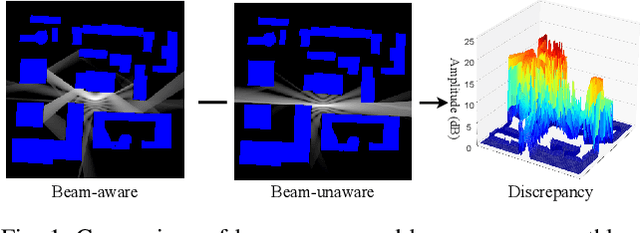
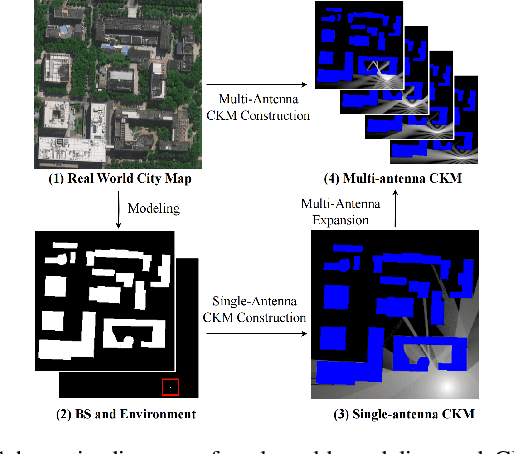
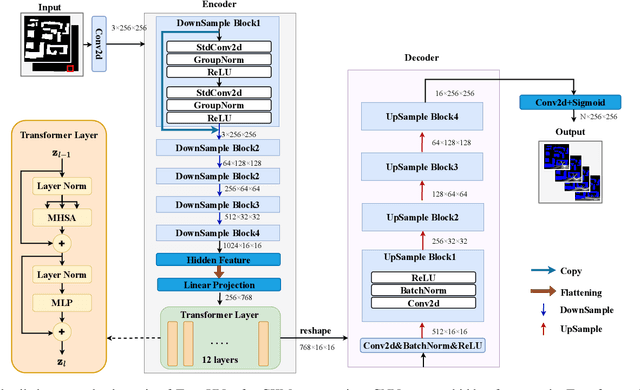
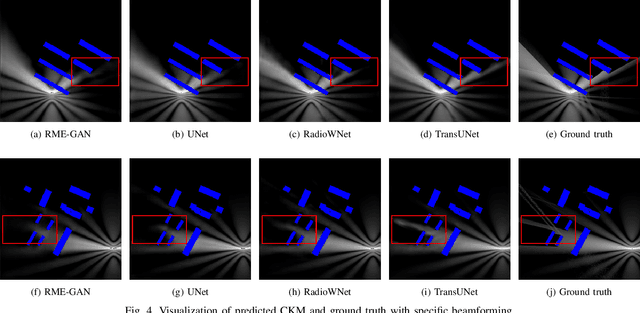
Channel knowledge map (CKM) has emerged as a crucial technology for next-generation communication, enabling the construction of high-fidelity mappings between spatial environments and channel parameters via electromagnetic information analysis. Traditional CKM construction methods like ray tracing are computationally intensive. Recent studies utilizing neural networks (NNs) have achieved efficient CKM generation with reduced computational complexity and real-time processing capabilities. Nevertheless, existing research predominantly focuses on single-antenna systems, failing to address the beamforming requirements inherent to MIMO configurations. Given that appropriate precoding vector selection in MIMO systems can substantially enhance user communication rates, this paper presents a TransUNet-based framework for constructing CKM, which effectively incorporates discrete Fourier transform (DFT) precoding vectors. The proposed architecture combines a UNet backbone for multiscale feature extraction with a Transformer module to capture global dependencies among encoded linear vectors. Experimental results demonstrate that the proposed method outperforms state-of-the-art (SOTA) deep learning (DL) approaches, yielding a 17\% improvement in RMSE compared to RadioWNet. The code is publicly accessible at https://github.com/github-whh/TransUNet.
HoloDx: Knowledge- and Data-Driven Multimodal Diagnosis of Alzheimer's Disease
Apr 27, 2025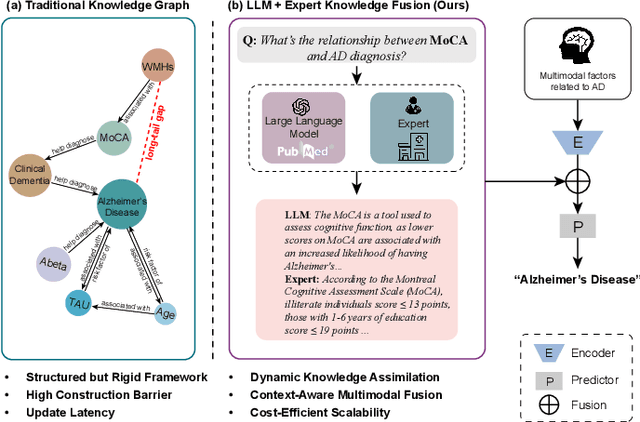
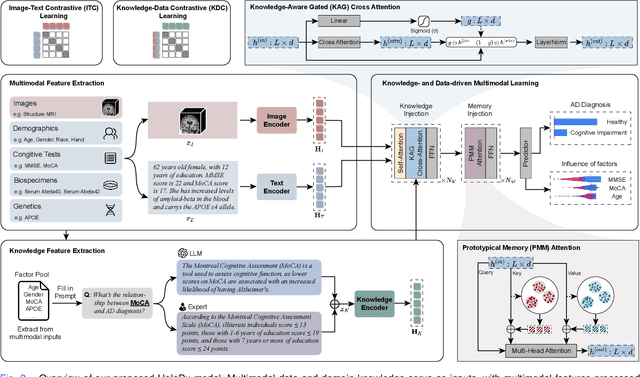
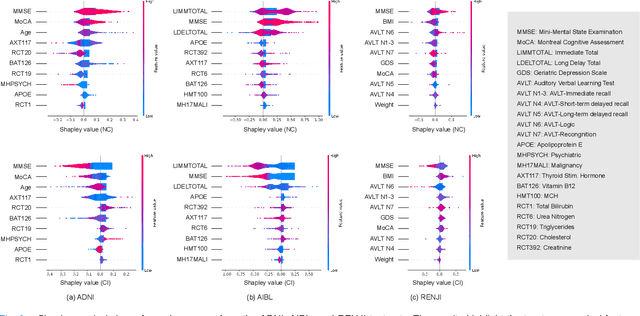
Accurate diagnosis of Alzheimer's disease (AD) requires effectively integrating multimodal data and clinical expertise. However, existing methods often struggle to fully utilize multimodal information and lack structured mechanisms to incorporate dynamic domain knowledge. To address these limitations, we propose HoloDx, a knowledge- and data-driven framework that enhances AD diagnosis by aligning domain knowledge with multimodal clinical data. HoloDx incorporates a knowledge injection module with a knowledge-aware gated cross-attention, allowing the model to dynamically integrate domain-specific insights from both large language models (LLMs) and clinical expertise. Also, a memory injection module with a designed prototypical memory attention enables the model to retain and retrieve subject-specific information, ensuring consistency in decision-making. By jointly leveraging these mechanisms, HoloDx enhances interpretability, improves robustness, and effectively aligns prior knowledge with current subject data. Evaluations on five AD datasets demonstrate that HoloDx outperforms state-of-the-art methods, achieving superior diagnostic accuracy and strong generalization across diverse cohorts. The source code will be released upon publication acceptance.
Lightweight and Self-Evolving Channel Twinning: An Ensemble DMD-Assisted Approach
Apr 23, 2025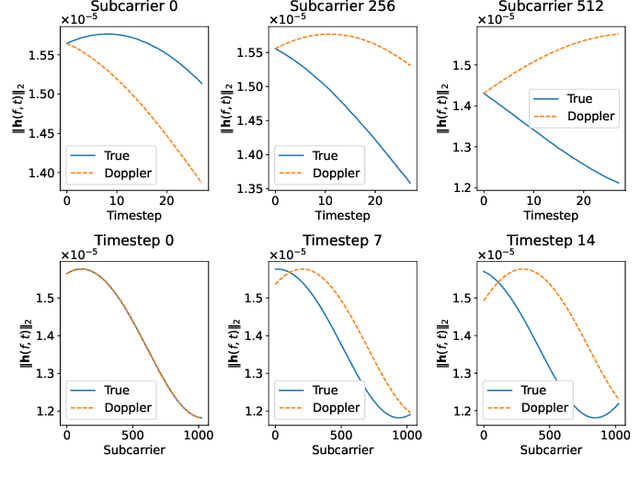
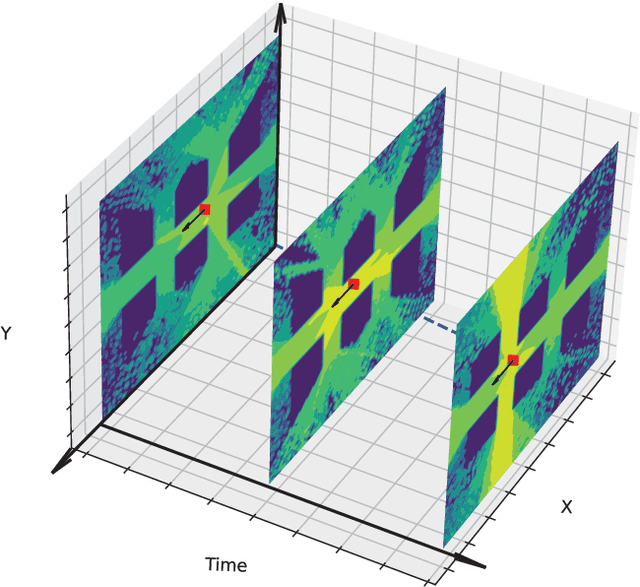
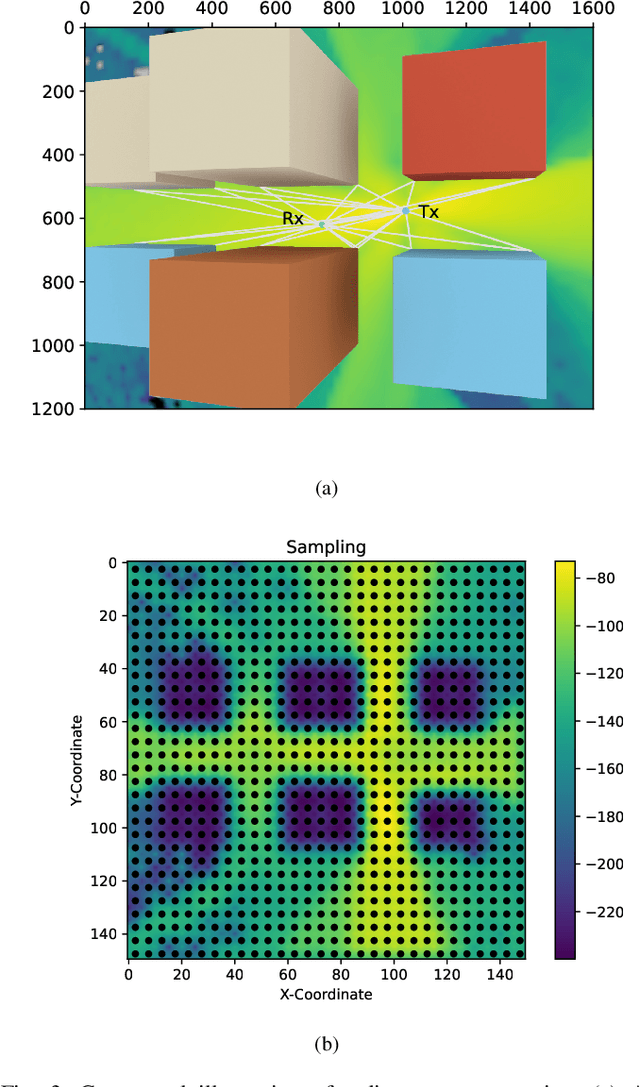
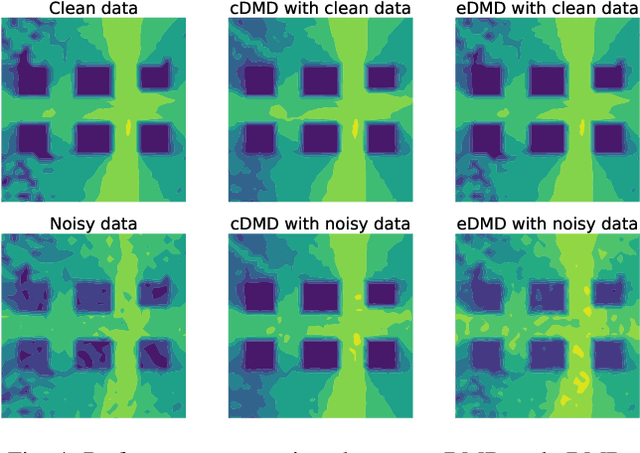
Traditional channel acquisition faces significant limitations due to ideal model assumptions and scalability challenges. A novel environment-aware paradigm, known as channel twinning, tackles these issues by constructing radio propagation environment semantics using a data-driven approach. In the spotlight of channel twinning technology, a radio map is recognized as an effective region-specific model for learning the spatial distribution of channel information. However, most studies focus on static channel map construction, with only a few collecting numerous channel samples and using deep learning for radio map prediction. In this paper, we develop a novel dynamic radio map twinning framework with a substantially small dataset. Specifically, we present an innovative approach that employs dynamic mode decomposition (DMD) to model the evolution of the dynamic channel gain map as a dynamical system. We first interpret dynamic channel gain maps as spatio-temporal video stream data. The coarse-grained and fine-grained evolving modes are extracted from the stream data using a new ensemble DMD (Ens-DMD) algorithm. To mitigate the impact of noisy data, we design a median-based threshold mask technique to filter the noise artifacts of the twin maps. With the proposed DMD-based radio map twinning framework, numerical results are provided to demonstrate the low-complexity reproduction and evolution of the channel gain maps. Furthermore, we consider four radio map twin performance metrics to confirm the superiority of our framework compared to the baselines.
Reconfigurable Codebook-Based Beamforming for RDARS-Aided mmWave MU-MIMO Systems
Apr 02, 2025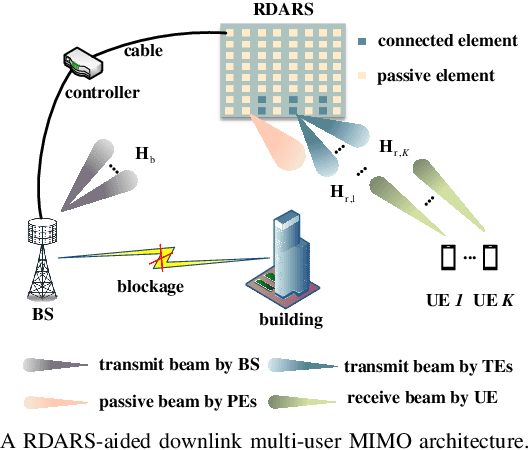
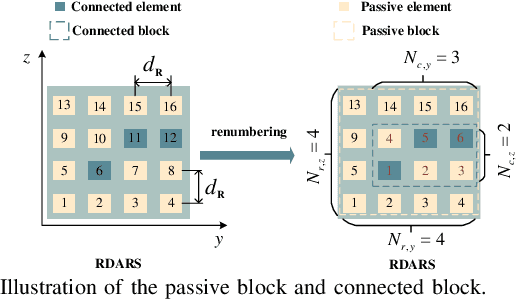
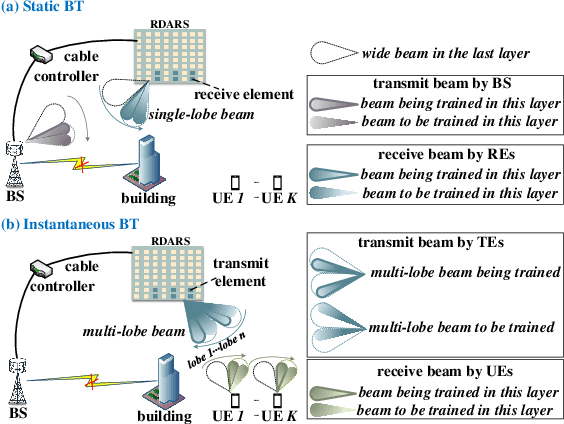
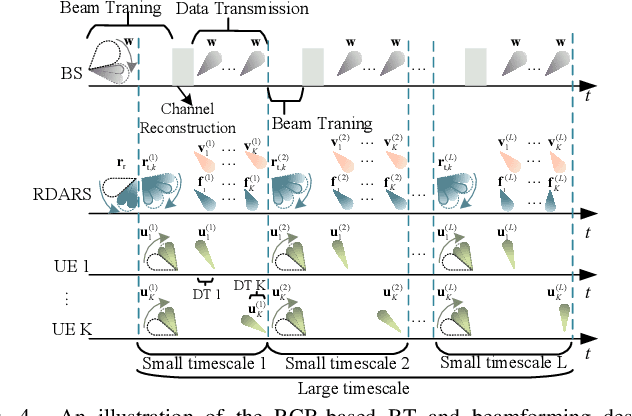
Reconfigurable distributed antenna and reflecting surface (RDARS) is a new architecture for the sixth-generation (6G) millimeter wave (mmWave) communications. In RDARS-aided mmWave systems, the active and passive beamforming design and working mode configuration for reconfigurable elements are crucial for system performance. In this paper, we aim to maximize the weighted sum rate (WSR) in the RDARS-aided mmWave system. To take advantage of RDARS, we first design a reconfigurable codebook (RCB) in which the number and dimension of the codeword can be flexibly adjusted. Then, a low overhead beam training scheme based on hierarchical search is proposed. Accordingly, the active and passive beamforming for data transmission is designed to achieve the maximum WSR for both space-division multiple access (SDMA) and time-division multiple access (TDMA) schemes. For the TDMA scheme, the optimal number of RDARS transmit elements and the allocated power budget for WSR maximization are derived in closed form. Besides, the superiority of the RDARS is verified and the conditions under which RDARS outperforms RIS and DAS are given. For the SDMA scheme, we characterize the relationship between the number of RDARS connected elements and the user distribution, followed by the derivation of the optimal placement positions of the RDARS transmit elements. High-quality beamforming design solutions are derived to minimize the inter-user interference (IUI) at the base station and RDARS side respectively, which nearly leads to the maximal WSR. Finally, simulation results confirm our theoretical findings and the superiority of the proposed schemes.